 Flyingin Russia
©1995 Scott Highton
For those wanting to fly their own aircraft into and within Russia, meticulousplanning and attention to detail can help reduce the difficulties that arebound to arise.
- Vaccinations
- The current vaccination recommendations for travel in eastern Russia include polio, diphtheria/tetanus and a gamma globulin injection. Ideally, these should be administered 10-14 days before departure. Check with your local traveler's health clinic for updates on the areas you plan to visit. Additionally, you should bring all personal medications you might need, since even the most basic over-the-counter drugs are unavailable.
Return toFriendship Flight 1995
Return to Picture Story index
 Flight Authorization
 - A request for flight authorization, or CDS, must be submitted by telex to the Ministry of Civil Aviation in Moscow. Reportedly, Moscow will not accept this by fax, so the telex delivery is important. You must also be able to receive a telex response from them. CDS forms should be telexed to the International Department, Ministry of Civil Aviation, Moscow, CIS TELEX: 412303 CDSSU.
- The CDS should include descriptions of the purpose of your trip, aircraft and pilot information, a passenger list with birth dates and passport numbers, a general declaration (regarding health, weapons, drugs, etc.) and a flight plan, including dates and times of arrival/departure. Flight plans can be delayed or extended almost indefinitely, but cannot be started earlier than the original time specified. Be sure to list these dates and times as the earliest you might possibly travel. Flight plans must be filed 24 hours in advance, and the CDS should be telexed as early as possible to allow Moscow sufficient time for processing and approval.
- All forms, including customs declarations and passenger lists, should be completed before arriving in Russia, and preferably type written. The customs officers in Russia do not like standing around waiting for you to fill out their forms. Generally, three copies of each are required, and there are often no copy machines available. Carrying a small supply of carbon paper can be helpful.
- The best advice for those planning flights into Russia, is to talk with pilots who have done it before. Keep in mind that information supplied by Russian officials may not even be complete, as important elements sometimes get lost in translation. Also, Russian aviation officials are not used to dealing with the concerns of non-IFR aircraft with limited flight ranges. Pilots who have endured the process before can offer a wealth of knowledge for the first time visitor.
Return toFriendship Flight 1995
Return to Picture Story index
 Flight Operations
 - In general, tower and weather reporting stations operate between the hours of 8 a.m. to 5 p.m. local time, although the major airports operate 24 hours a day. Aircraft are not permitted to land at an airport when the tower is closed. Russia is a large country that includes 11 time zones, so it's important to know the time difference at your destination when planning around tower closures. Navaids, such as ILS approaches and NDBs are often turned off to save energy, as is radar at the smaller towers, unless aircraft are expected. Navaids in Russia are exclusively NDBs. ILS approaches are usually set up on two NDBs.
- Many towers do not have English-speaking personnel available, so it is often required to hire a Russian navigator. They cost about $180 per day, plus their expenses, and are hired from Moscow. Their fee is only charged for the days they actually fly, and having one along makes it possible to communicate with any tower. They can also be helpful in easing any political problems you might encounter, and their familiarity with the terrain and country can be invaluable. As the Friendship Flight discovered, it is important to make sure that your Russian navigator is also fluent in English. This may seem an obvious point, but based on experience, it should not be assumed.
- A turbocharged aircraft will allow you to fly high enough to always be in contact with an English-speaking controller. If you have a high frequency (HF) radio, you can communicate with them at altitudes below line-of-sight levels.
- Pilots should have the ability to fly IFR, even if they are planning a VFR trip. You will not be allowed to depart if the weather at your destination is below, or forecast below, minimums for your arrival. Minimums are usually 1,000 foot ceilings and 3-5 miles visibility. Use the published airways, whenever possible. Altitudes are given in meters, not feet, so multiply the number of meters by three for a rough conversion.
-
- The Russians use altimeter settings differently than most of the rest of the world. In the U.S., we use a QNH system, where altimeters are set to 29.92 in the flight levels, but are based upon corrected MSL readouts at lower altitudes. This means that our altimeters read and are set to the actual field elevation when the plane is on the ground.
- Russia, however, uses a QFE system, where all enroute flight above 2,000 meters is done with the altimeter set to 29.92. When in an airport traffic area, though, the tower gives altimeter settings which will read zero when the plane is on the ground, no matter what the field elevation is. Thus, their airport area altimeter settings provide AGL (from the reporting airport) readouts. This can result in a lot of knob twisting during transitions, and all but guarantees that you'll never know what your true altitude above sea level is during flight.
- Minimum enroute altitudes are based upon flight over either mountainous or non-mountainous terrain. For VFR flight, the MEA is 300 meters above the highest obstacle in mountainous areas, or 100 meters over the highest point in non-mountainous areas.
 Aircraft Fuel
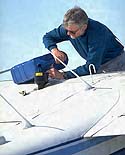
 - Jet fuel is readily available throughout Russia, but avgas is somewhat rare and usually only available in 91 octane. Be sure to inspect all fuel before putting it into your tanks. Magadan officials dispatched an AN-26 loaded with 91 octane avgas to Markovo for refueling of the Friendship Flight. Unfortunately, the portable pump they included was used previously for JP-4 jet fuel. Several quarts of JP-4 contaminated avgas were pumped into the tanks of the Cessna 310 before the problem was discovered. Although the error didn't cause any problems for the rest of the trip, it certainly offers good reason to check fuel carefully.
- The current reality of flight in Eastern Russia is that lack of readily available avgas virtually prohibits general aviation aircraft except those capable of long-range IFR flight. The distance between Nome and Magadan, the first airport with avgas normally available, is roughly 1,600 miles. Without bringing fuel in from the U.S. ahead of time and pre-positioning it along the route, most general aviation aircraft wouldn't have the range to make such a flight. It was only with the cooperation of Bering Air and the Russian hosts positioning fuel along the route, that the Friendship Flight, including smaller aircraft such as the Cessna 172 and two Heliocouriers, was even possible.
Return toFriendship Flight 1995
Return to Picture Story index
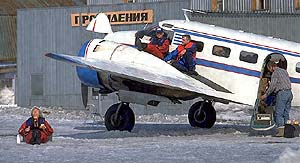 Clearing Customs
 - Avoid bringing firearms into Russia, even though you may have one as part of your aircraft wilderness survival kit. Gold jewelry should also be left at home. You will likely be asked to count all your money in front of the customs officers, both when entering and leaving the country. The amount you leave with, plus purchases you have receipts for, should match the amount you came in with. The current exchange rate is about 5,000 rubles to the U.S. dollar.
- Handheld two-way radios are restricted. All such equipment (as well as signal flare guns) should be left in the aircraft at all times and, if questioned, should be claimed as aircraft equipment. Airport security is generally quite good. Leave as much as you can in the airplane and only go through customs with what you need for your overnight stay. Itemize and declare valuables such as cameras, computers and personal electronic devices.
- Most importantly, be aware of U.S. customs regulations prohibiting the possession of ivory, seal furs or any products made from marine mammals or endangered species when reentering the U.S. Don't buy these items, even though they may be perfectly legal in Russia. The pilots in command of private aircraft can be held responsible for violations by their passengers or crew, which can result in seizure and loss of their aircraft, as well as large fines and a possible jail sentences. All this can be imposed for something as small as a pocket-sized ivory carving.
- Equipment and Survival Gear
- Crossing the Bering Strait, even at its narrowest point over the Diomede Islands, means about 70 miles of over water exposure. The exposure is about 200 miles for the direct IFR route from Nome to Provideniya. Even if there is a winter ice pack, the span of frigid water presents a significant risk for single engine aircraft. Survival suits are a necessity in case of a water landing. The human body can only survive unprotected in these waters for a few minutes.
- Other basic survival and camping gear should also be carried for flights to Eastern Russia. If your plane goes down, you might wait many days for rescue, so it's best to be prepared. The lack of overnight facilities at many small airports also means pilots and crews should be equipped to camp at the airport or wait out the weather with their planes, if necessary.
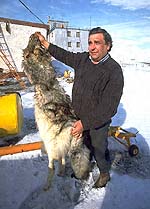 General Planning
 - Prepare as thoroughly as possible for flights to Russia. Always have several backup plans. To Americans, Russian society appears to consist of countless individuals each controlling their own little fiefdoms. Patience can be a tremendous virtue when dealing with problems. Give the local officials time to resolve situations among themselves before reacting to sudden demands. Go with the flow and go slowly whenever possible.
- Conditions in small towns are often primitive, at best, especially when compared to what we're used to in the U.S. Water should be treated in remote areas, including many cities, and it's a good idea to bring your own supply of toilet paper. The Russian people are generally reserved, yet warm and friendly once you initiate contact. They seem very happy to meet and talk with Americans.
- Bring many small tokens or gifts when you visit, as it is tradition to give a small offering to anyone who serves as your host, whether it be for a meal or simply inviting you to visit them in their home. Uniquely American items are appreciated, including pins, small flags, mugs, candy, food, baseball caps and items containing the logos of well-known American companies. Postcards, small picture books and personal photos of your home town or family provide great conversation starters, and help the people you meet get to know you better. Stay in touch with those you do meet, especially after you return home. Letters from American guests are precious.
- Flying small aircraft to Russia is still somewhat of an adventure, particularly in a world where true adventure has become more elusive. Allow yourself far more time than you expect, and be willing to change your plans along the way if necessary. The journey itself, will be the reward.
Return toFriendship Flight 1995
Return to Picture Story index